

AI for Multi-hazard Early Warning and Rainfall Modeling
Research on rainfall modeling and multi-hazard early warning since 2024. A representative outcome is RainGod-100, combining satellite, radar, and rain-gauge observations for forecasts up to two hours ahead; contributed to model design, training, and release.
Featured outcome · RainGod-100
RainGod-100 Precipitation Nowcasting Model
A precipitation nowcasting model that fuses satellite, weather-radar, and rain-gauge observations with physical modeling and artificial intelligence to directly produce rainfall forecasts up to two hours ahead, supporting early warning for flash floods, debris flows, landslides, and urban flooding.
Personal contribution: contributed to the model's design, training, and release
Overview
Research, development, and application of multi-hazard early-warning technologies and rainfall foundation models. The work was advanced at the Institute of Chengdu High-Tech Disaster Reduction and the Institute of Mountain Hazards and Environment from 2024 to 2026, and continues as a core line of doctoral research.
Scope
- Multi-hazard monitoring, forecasting, and early-warning technologies
- Precipitation nowcasting and rainfall foundation models
- From model research and system development to real-world application
Representative Outcome: RainGod-100
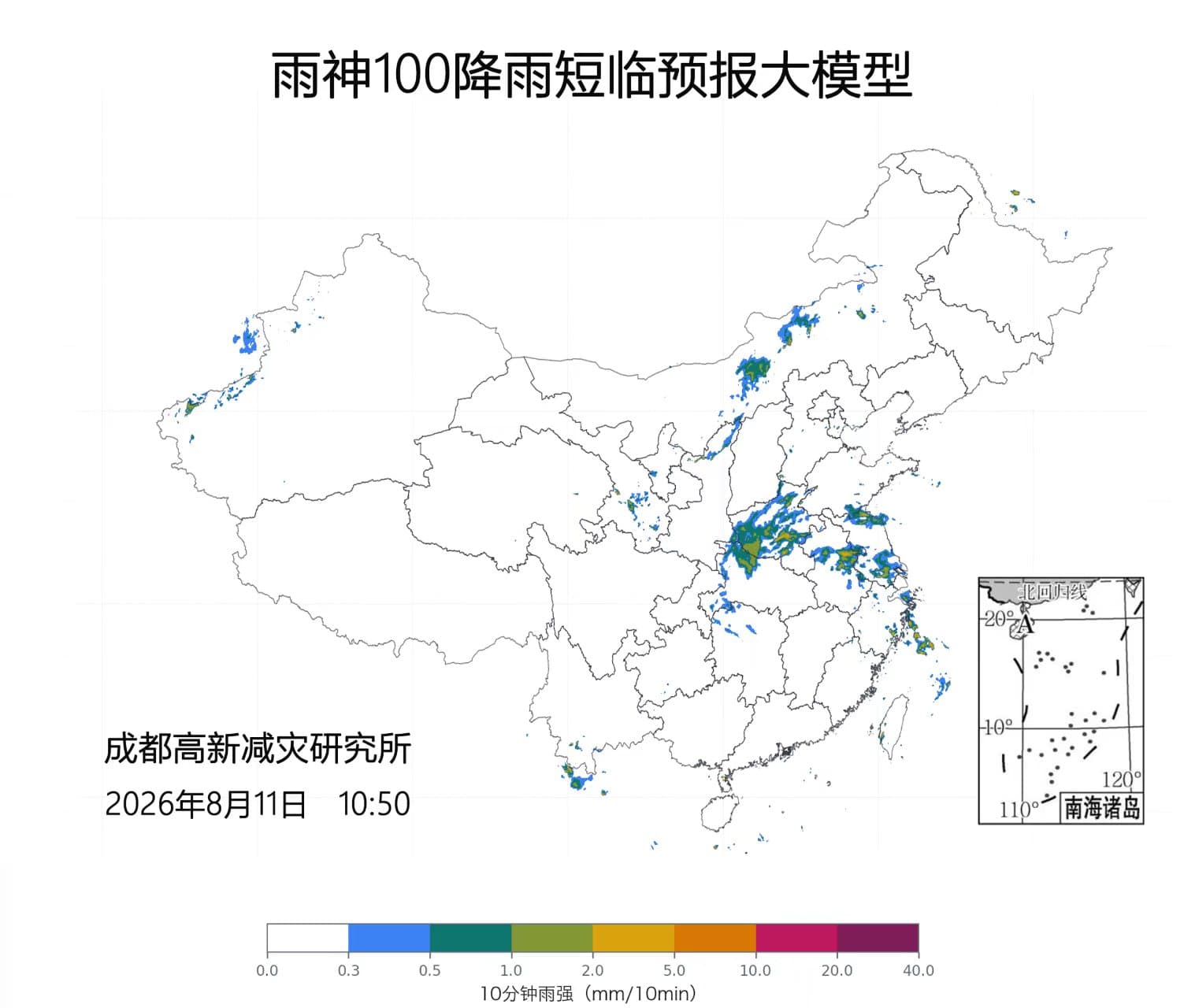
RainGod-100 is a precipitation nowcasting model that combines satellite, weather-radar, and rain-gauge observations with physical modeling and artificial intelligence. It directly produces rainfall forecasts for the next 0–2 hours, supporting early warning for flash floods, debris flows, landslides, and urban flooding.
The forecast example is a ten-minute rainfall-intensity forecast over China produced on August 11, 2026. It is a recorded model output, not a live forecast.
My Contribution
Contributed to the model's design, training, and release. The broader research spans multi-hazard early-warning technologies and rainfall foundation models, and continues as a doctoral research direction.
From Observations to Early-warning Support
- Observations: satellite imagery, weather radar, and rain gauges provide complementary rainfall information.
- Modeling: physical modeling and AI are combined to generate short-range rainfall forecasts.
- Application: rainfall predictions provide input for warning about multiple types of hazard.
The rainfall forecast is one part of the broader early-warning work.