

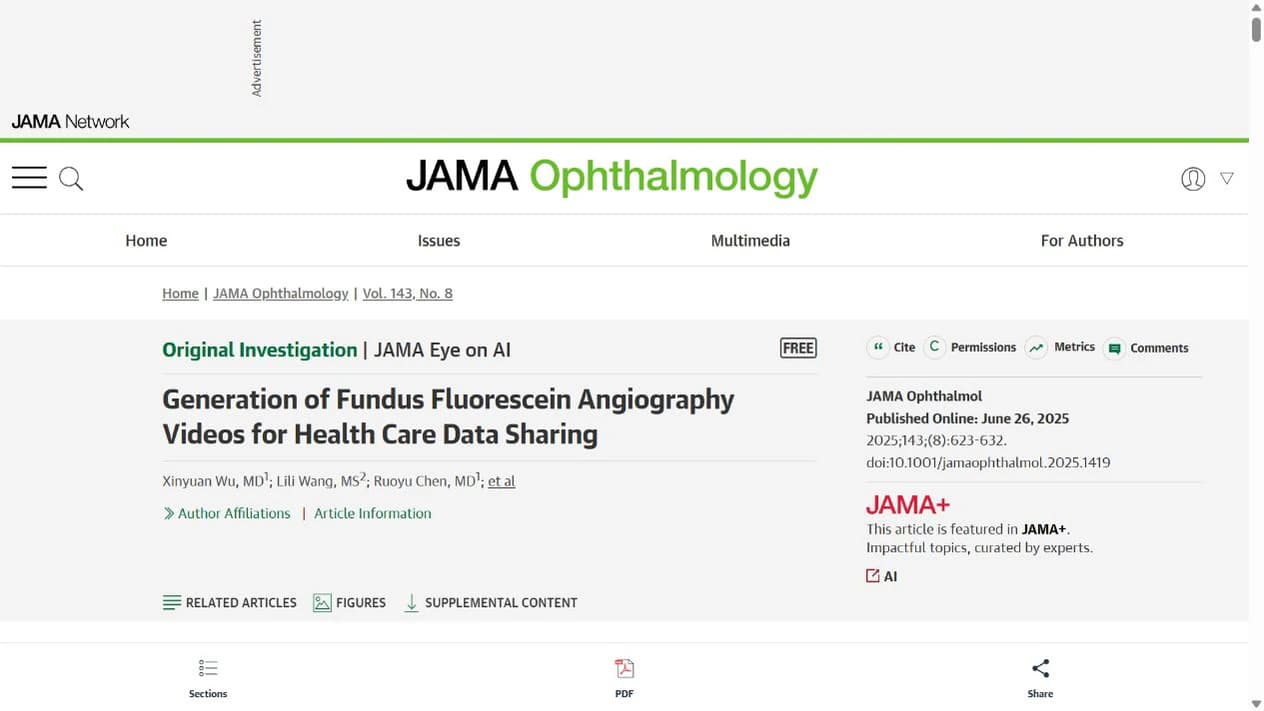
Generation of Fundus Fluorescein Angiography Videos for Health Care Data Sharing
Generates dynamic fundus angiography videos from clinical text to explore privacy-aware medical data sharing. Combines a Wavelet-Flow VAE and Diffusion Transformer; published in JAMA Ophthalmology (2025).
Overview
A text-to-video model that generates dynamic fundus fluorescein angiography (FFA) videos from clinical text descriptions, supporting privacy-aware medical data sharing. The work was published in JAMA Ophthalmology (2025; 143(8): 623–632).
Problem
Sharing real patient imaging involves privacy constraints that affect research, education, and model development. This project explores generating dynamic imaging from clinical descriptions as another route for medical data sharing.
My Role
Co-first author, published under the academic name Lili Wang. Contributed to model development with Python and PyTorch, including the integration of the Wavelet-Flow VAE and Diffusion Transformer for spatiotemporal modeling of fundus lesion features.
The documented author contributions also include study conception and design, data acquisition and interpretation, manuscript drafting, and statistical analysis.
Approach
The workflow connects three elements:
- Input: clinical text descriptions of an FFA examination
- Model: a Wavelet-Flow VAE combined with a Diffusion Transformer
- Output: a generated dynamic FFA video
The study used 3,625 anonymized FFA videos for training and evaluation. Evaluation covered objective quality metrics, text–video semantic consistency, ophthalmologist review, and image retrieval metrics to examine generation quality and privacy protection.
Results
The study was peer-reviewed and published in JAMA Ophthalmology (2025). It explores a technical approach to clinical visualization, medical education, and privacy-aware data sharing. The paper provides the experimental setup and detailed results.
Links
- Publication: DOI 10.1001/jamaophthalmol.2025.1419